Western Water Leadership After the 2026 Elections: Continuity Amid Change
By J.D. Strong, Executive Director
The November 3 elections brought significant changes to the political landscape across the American West. For those involved in water management, the results offer an opportunity to look beyond their own state boundaries and consider what colleagues throughout the region are experiencing as new administrations prepare to take office.
Across the 19 western states within the Western States Water Council’s (WSWC) geographic footprint, 15 held gubernatorial elections this year. At least nine will begin the next term with a different governor, including states where the incumbent’s political party retained control. Other states reelected their governors or had no gubernatorial election at all.
While political circumstances vary considerably, the responsibilities of managing the West’s water resources—and the value of cooperation among the states—remain constant.
A Changing Landscape Across the West
The 2026 gubernatorial elections produced a combination of political change and continuity.
Two states changed political parties: In Nevada, Democrat Aaron Ford defeated incumbent Republican Governor Joe Lombardo. In Texas, Democrat Gina Hinojosa defeated incumbent Republican Governor Greg Abbott.
Five states elected new governors without changing parties: California elected Xavier Becerra (D); Colorado elected Phil Weiser (D); New Mexico elected Deb Haaland (D); Oklahoma elected Mike Mazzei (R); and Wyoming elected Eric Barlow (R).
Six incumbent governors won reelection: Katie Hobbs in Arizona, Josh Green in Hawaii, Brad Little in Idaho, Jim Pillen in Nebraska, Tina Kotek in Oregon, and Larry Rhoden in South Dakota.
Four states held no gubernatorial election: Montana, North Dakota, Utah, and Washington.
Two gubernatorial contests remained unresolved as of November 6: In Kansas, Democrat Cindy Holscher held a narrow lead over Republican Ty Masterson, with a close-race audit underway. In Alaska, Democrat Jonathan Kreiss-Tomkins led in first-choice votes, with additional counting and ranked-choice tabulation scheduled for November 18. Both states will have new governors because their incumbents are term-limited.
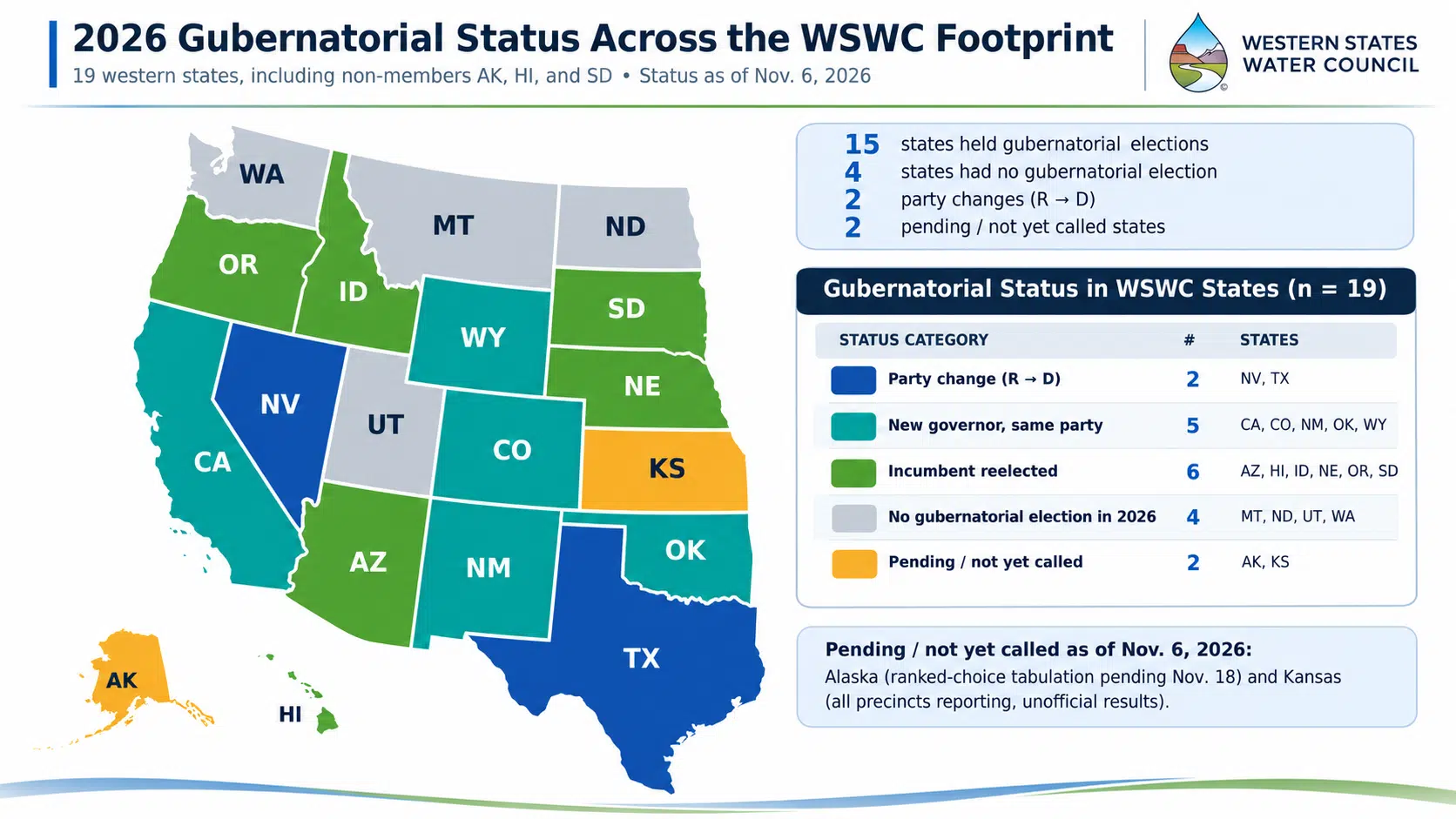
These results illustrate the extent of leadership transitions underway across the region. They also underscore an important distinction: a change in governor does not necessarily mean a change in political party, and continuity in the governor’s office does not mean a state’s policy priorities will remain unchanged.
Water Management Across Administrations
For western water officials, elections are only one part of a much longer timeline.
Water supply planning, infrastructure development, water rights administration, drought and flood preparedness, water quality protection, Indian water rights settlements, and interstate river management routinely span multiple gubernatorial administrations. Many decisions made today will have consequences for communities, economies, and ecosystems decades into the future.
These responsibilities require institutional knowledge, sound science, effective partnerships, and sustained public service. They also depend upon professional relationships that extend beyond political affiliations and election cycles.
Having served under four Oklahoma Governors from both political parties during more than three decades in public service, I have witnessed this continuity firsthand. I also had the privilege of representing Oklahoma on WSWC across a change in gubernatorial administrations. While administrations and policy priorities evolve, the importance of maintaining constructive working relationships—and learning from colleagues facing similar challenges—endures.
That shared experience is particularly relevant following this year’s elections. Some western states are preparing for new governors and potentially new approaches to longstanding challenges. Others will continue under familiar leadership. Yet all remain responsible for managing water resources within their respective legal, geographic, and institutional circumstances.
Regardless of the political landscape, the West’s water challenges do not observe election calendars.
The Enduring Value of Interstate Cooperation
Since its creation by western governors in 1965, WSWC has brought state water leaders together to exchange information, develop consensus policy positions, and collaborate on matters of regional and national significance. The WSWC also provides a collective western-state voice before Congress and federal agencies, advancing policies, programs, and investments that recognize the West’s distinct water challenges, respect state authority, and strengthen federal-state partnerships.
These roles are particularly valuable during periods of political transition.
Through WSWC, states can draw upon their neighbors’ knowledge and experience, share approaches to common challenges, and maintain constructive dialogue even as individual administrations and priorities change.
These relationships matter because western states confront many of the same fundamental issues, although their circumstances and approaches may differ substantially. Water scarcity, infrastructure needs, federal-state coordination, and reliable water data and forecasting all demand sustained attention.
WSWC’s work does not depend upon agreement on every issue. Rather, its strength lies in providing a forum where state officials can learn from one another, recognize shared interests, and identify opportunities for cooperation while respecting each state’s distinct responsibilities and authorities.
Political transitions also create opportunities to introduce new participants to these relationships, building upon the experience and contributions of those who have served before them.
Looking Ahead to 2027
As western states prepare for the next chapter in their political leadership, the WSWC looks forward to working with both continuing and newly appointed representatives, strengthening established relationships, and welcoming new perspectives.
The results of November 3 provide a useful snapshot of where the western states stand politically. The more enduring story, however, is the work that continues beyond the ballot box.
Governors and administrations will change. The West’s water challenges will remain. So, too, will the importance of informed, collaborative leadership and strong relationships among the states.
That commitment to collaboration has guided the WSWC for more than six decades—and will remain central to its work in the years ahead.
Editorial note: This article and accompanying graphic were developed with assistance from generative AI tools. Editorial oversight, fact-checking, and final content approval were provided by WSWC staff.